Help
ShyamMetalics powered by WhizCloud follows bulk raw material from the purchase order to the plant gate. The eight stages below are the same ones on every screen. The left-hand nav is Control Tower, Shipments, Live Map, Suppliers and Help. Plant deliveries opens when you switch to Plant stores.
Start here
The eight stages of an import
An import of bulk raw material is a slow chain of events, not a single delivery. It starts with a purchase order: we agree to buy a quantity of a named material, at a price, of a stated quality, to arrive in a window of dates. The supplier then names the ship. Until that name is accepted, nothing physical has moved.
The ship loads at an origin port in China or Australia and a Bill of Lading is issued. That document is the title to the goods, and its stated quantity is what we pay against. The ship then sails for India.
Haldia's river is too shallow for a fully laden ocean ship. Part of the cargo is moved into barges at Sandheads, and those barges come up-river while the ocean ship follows with whatever is left. Paradip can take the ship alongside, so there is no barge transfer there.
Everything is weighed, several times, and it never weighs the same twice: at origin, by weight survey when it is unloaded, on the trucks leaving the plot, and again at the plant weighbridge. The differences are usually small. Added together they are not.
Customs must be paid before the cargo may leave the port. Trucks then take it to Jamuria or Sambalpur, a few tonnes at a time, each trip with its own e-way bill. Only when the last truck has been weighed in do we know what a tonne actually cost.
Control Tower
Import operations and management
Lots due at an Indian port sit at the top. Upcoming supplier payments follow: chips look forward six months, three months, one month, two weeks or one week. Historical chips then switch the remaining charts between the last twelve, six or three months, or year to date — volume, supplier share, material mix, on-time arrival, delivered cost per tonne, the Haldia / Paradip split, and payments made. Each chart ends with a sentence and an Export CSV link. The bell in the black header, on every screen, lists what needs a person today.
Arriving soon
Lots with an Indian-port ETA in the next 15 days, soonest first, with the same journey rail as the register.
Upcoming payments
Cash still to leave, directly under arriving soon. Chips look forward six months, three months, one month, two weeks or one week. Daily bars for the short windows, monthly bars for the long ones.
Chart window
Last 12 months, 6 months, 3 months, or year to date. That window applies to volume, suppliers, materials, on-time arrival, delivered cost, port split and payments made — not to upcoming payments.
Volume and supplier share
Imported tonnes in the selected window, stacked by material, beside who supplied how much.
Payments made
Settled supplier payments in the same historical window, stacked by supplier, dated by the payment value date.
Needs attention (bell)
Plain language, no severity labels. The top notification is the shipment that has waited longest past its plan.
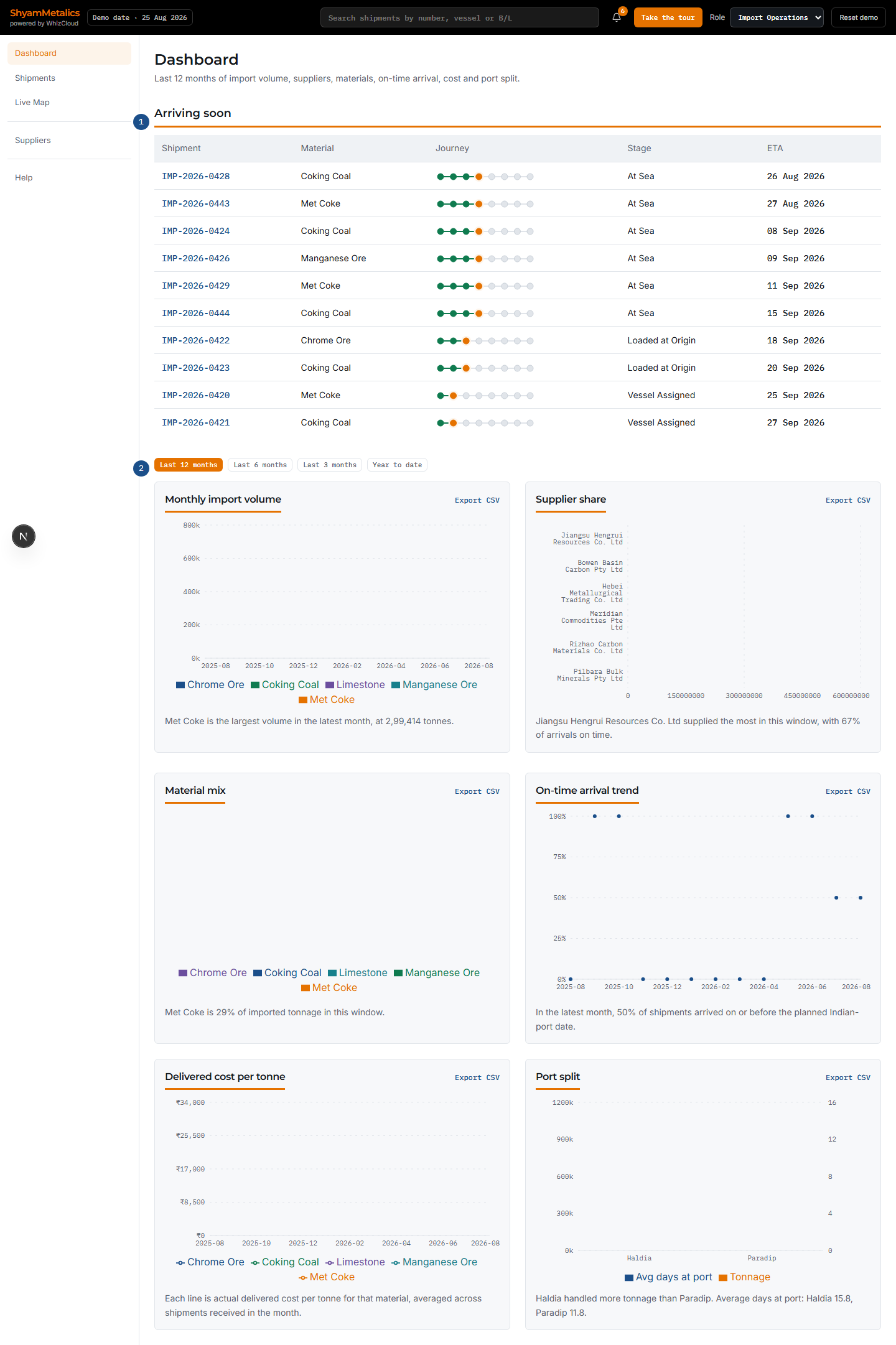
- 1Lots due at Haldia or Paradip, soonest first.
- 2Charts for the selected window — last 12, 6 or 3 months, or year to date.
Shipments
Anyone looking for a specific cargo
The full list of import lots, with a one-month calendar of Indian-port arrivals on top. A shipment is one lot of bulk raw material under one Bill of Lading — 45,000 tonnes of met coke on one ship, not a box in a warehouse. Chips and dropdowns filter the table in place. Each row carries the same eight-stage rail you see on every other screen.
Arrival calendar
One month at a time. Each chip is a shipment due at Haldia or Paradip that day — hover for the lot, material, tonnes and port, then click it to open the lot. Previous and Next move the window.
Stage chips
All, At Sea, At Port, In Customs, On Road, Delivered, Delayed. They filter the table without reloading the page. Material, supplier and origin sit in the dropdowns underneath.
Journey rail
Eight nodes, no labels. Completed stages are green, the current stage is orange, and a delayed current stage has a red ring. Hover for the stage name and date.
Shipped quantity
The quantity written on the Bill of Lading at the origin port. Later measurements are compared to this number.
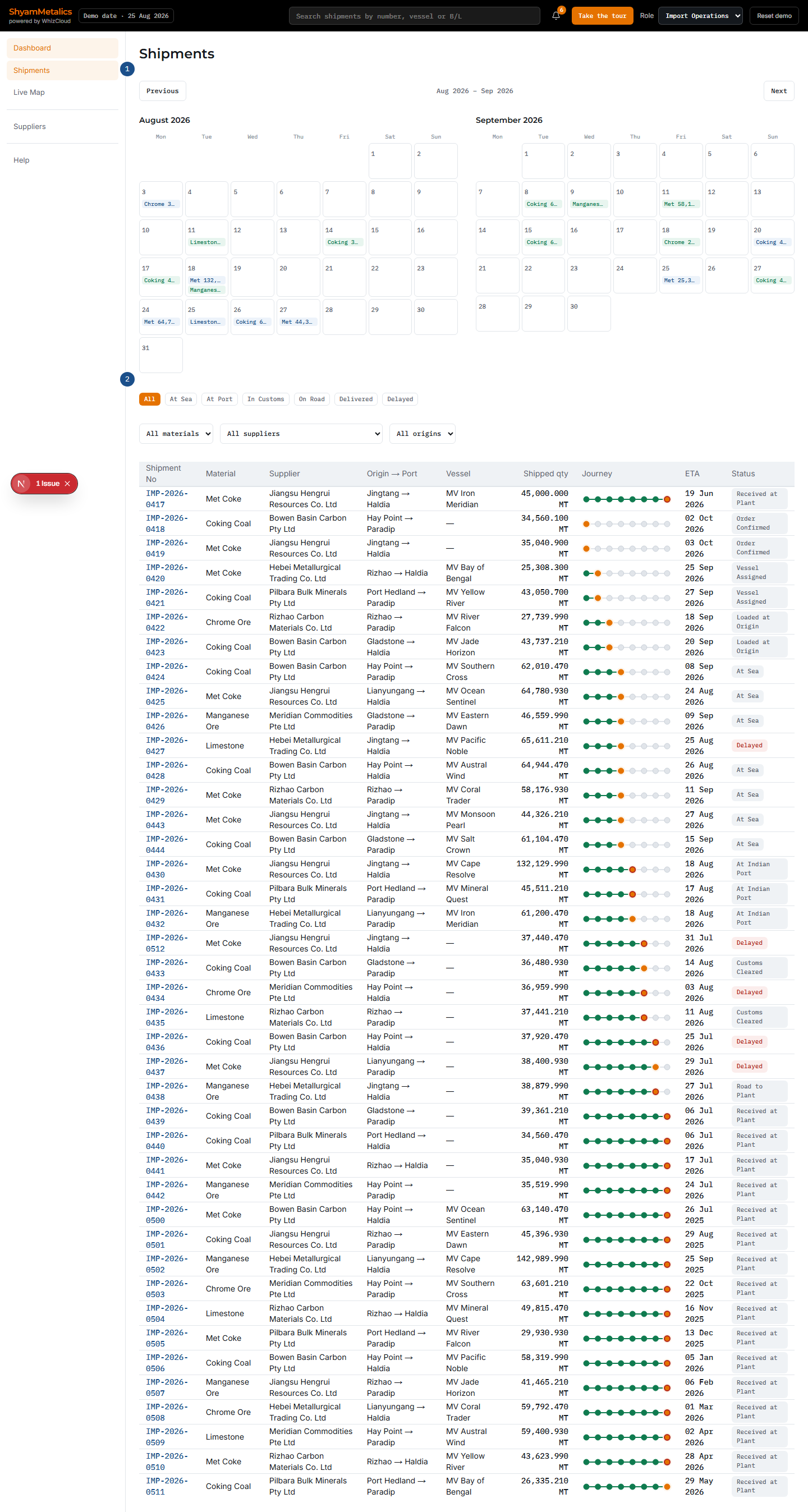
- 1Two months of Indian-port arrivals. Click a chip to open that shipment.
- 2Filter the list by where the cargo sits — no page reload.
Shipment detail
Everyone, as the starting point for one cargo
One cargo, end to end. The header names the material, the ship and the supplier. The journey pipeline is the same eight stages as everywhere else. Two cards under the rail say what matters now — where the lot is waiting, and what has been measured so far. After plant receipt those cards become quantity received against shipped, and delivered cost per tonne. Four tabs break the rest down: Journey, Cargo, Documents and Costs.
Now
Before the plant weighs the cargo, the two cards say where the lot sits and the last measurement that exists. They do not treat cargo still on the water or at port as a shortfall.
Quantity received against shipped
After plant receipt. On IMP-2026-0417 the papers said 45,000.000 MT. The plant recorded 44,610.400 MT. The gap is 389.600 MT.
Delivered cost per tonne
After plant receipt. What one tonne actually cost at the plant yard, against the budget. Quantity shortfall changes the denominator.
Journey
The route, delay-reason cards — a stage can have more than one reason — the voyage map, and planned versus actual dates on the stage list.
Cargo
What the material is for at the plant, the ordered → shipped → unloaded → received funnel, unloading including barge transfer where the Indian port is shallow, and origin versus Indian-port quality tests.
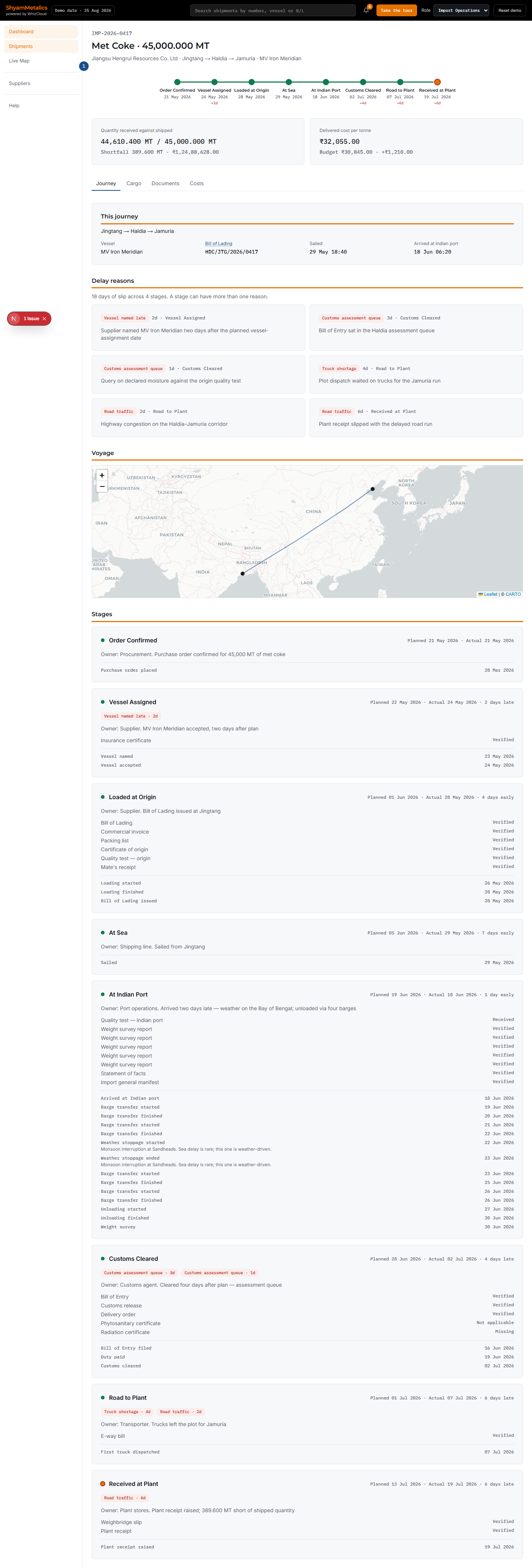
- 1The same eight stages as everywhere else
Live map
Import operations watching the sea leg
Every voyage on a light base map. Origin and Indian-port pins, a sea route, and the vessel at its current position, rotated to heading. Delayed vessels use the problem colour. The left column filters to delayed-only, China or Australia, and material. Click a ship for the shipment number, material, tonnage and ETA.
Progress
How far along the sea route the vessel has come, as a percentage.
Filters
Delayed only, origin country and material. Apply keeps you on this map; it does not open the shipment list.
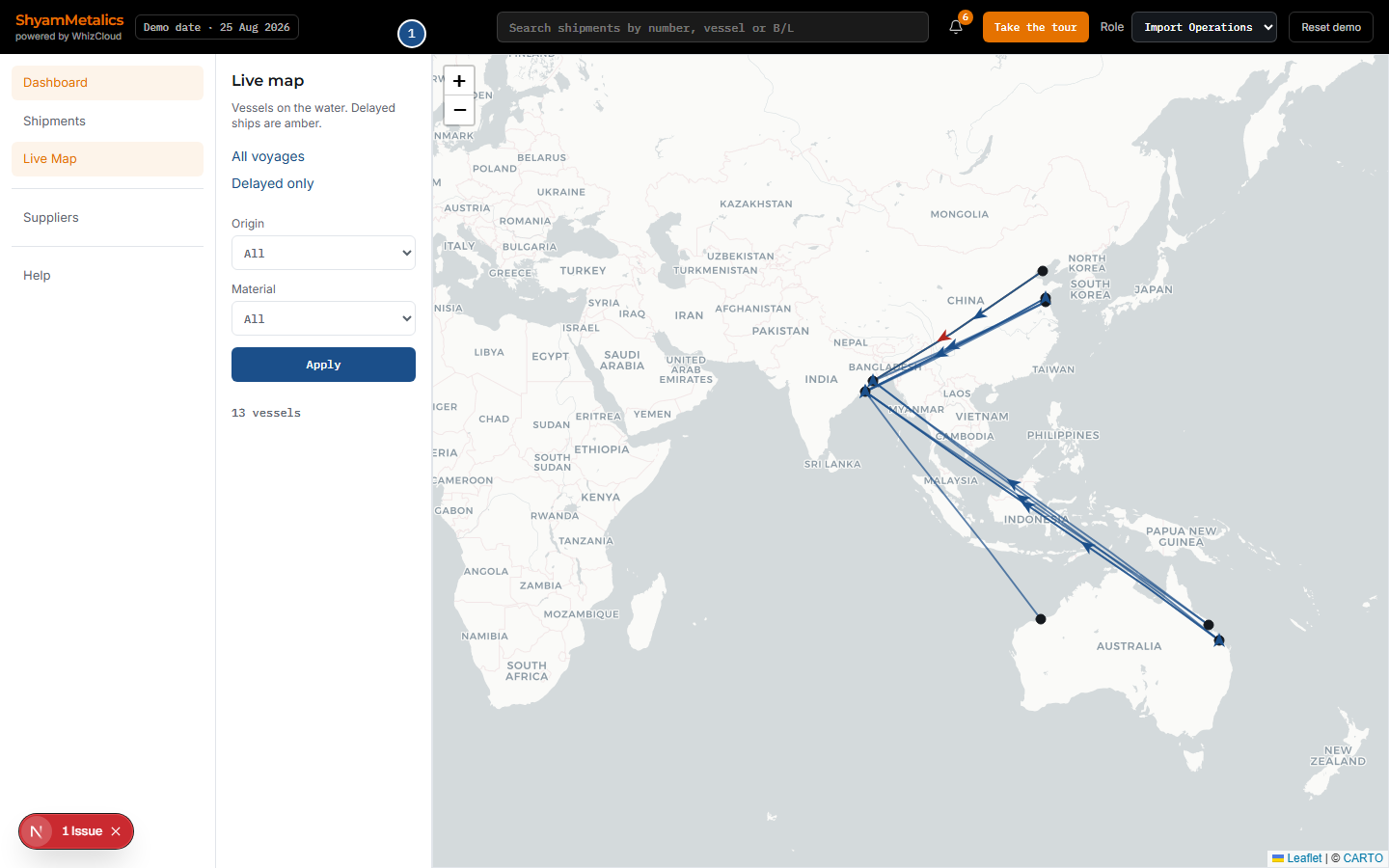
- 1Ships on the great-circle track; delayed vessels use the problem colour
Suppliers
Procurement
Who we buy from: tonnage supplied, shipment count, on-time percentage, average days at sea. No scorecard grades — the numbers are enough. Open a row for that supplier's shipments and a monthly volume table by material.
On-time
Share of that supplier's shipments whose Indian-port arrival was on or before the planned date.
Supplier shipments
Each lot with the same journey rail as the register. Volume by month is the last twelve months of that supplier only.
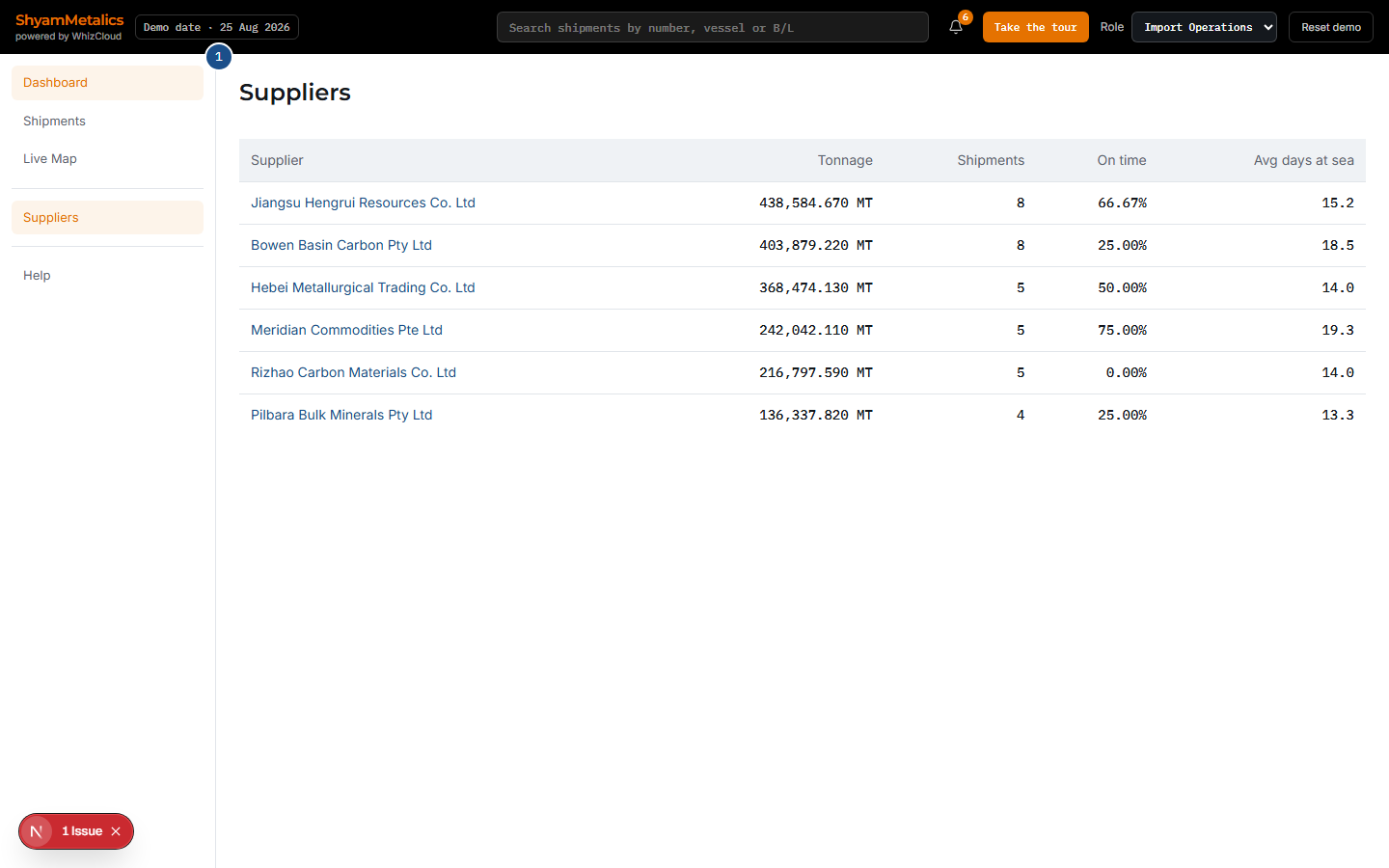
- 1Tonnage, shipment count and on-time percentage — no grades
Plant deliveries
Plant stores
Arrivals at the plant gate — the Plant stores home, opened by switching role in the header rather than from the left-hand nav. A fourteen-day bar chart of tonnes received, a two-month Indian-port arrival calendar, then trucks grouped by day, today first. Trucks still on the road sit at the bottom.
Tonnes received
Last fourteen days at the plant weighbridge.
Arrival calendar
Two months of Indian-port ETAs. Hover a chip for details; click it to open that lot.
Weighbridge net
Gross less tare. Compared with the dispatched weight, this is where road shortfall shows up.

- 1Tonnes received, the arrival calendar, then trucks by day
Help
Anyone seeing the product for the first time
Start-here cards by role, the eight stages of an import, a short guide to each screen, and a glossary of the terms that appear on the client's own paperwork. Take a tour, in the header, walks the same ground on the live screens.
What is real, what is simulated
Calculated here
The quantity funnel and delivered-cost engines are real functions. They take the same inputs the screens show and they are covered by unit tests. Change a seed figure and the screens move with it.
Simulated
Vessel positions, AIS tracks, customs status and document extraction are read from seed data. There is no live feed. The demo date is fixed at 25 August 2026.
Not in this build
No database, no login, no network calls at runtime. Mutations live in memory until the server restarts. Reset demo clears them.
Glossary
- At Indian Port
- Arrived and unloading, including barge transfer where the port is shallow.
- At Sea
- Sailing from China or Australia to India.
- Barge
- The smaller vessel that carries cargo from the anchorage up-river to the berth.
- Barge transfer
- Moving cargo from the ocean ship into barges because the Indian port is too shallow for the loaded vessel. Used at Haldia, from Sandheads.
- Bill of Entry
- The customs declaration filed in India. Duty is assessed against it; cargo cannot leave the port until it is cleared.
- Bill of Lading
- The title document issued when cargo is loaded. Its quantity is the shipped quantity we pay against.
- Customs agent
- The firm that files the Bill of Entry and steers the cargo through customs.
- Customs cleared
- Duty paid and the cargo released by customs. Until this happens, trucks cannot leave the plot.
- Delivered cost per tonne
- Everything one tonne cost by the time it stood in the plant yard, divided by the tonnes that actually arrived.
- Delivery terms
- Who pays ocean freight and where risk passes — CFR, CIF, FOB and the rest. Shown as the three-letter code on the contract.
- Dry basis
- A quantity or quality figure with moisture stripped out, used for pricing some coals and coke.
- E-way bill
- The road tax document that must travel with each truck from port to plant. It can expire on the road.
- Indian port
- Where the cargo is unloaded in India — Haldia or Paradip.
- Loaded at Origin
- Cargo aboard, Bill of Lading issued.
- Main vessel
- The ocean-going ship that loaded the cargo at origin.
- Order Confirmed
- Purchase order placed with the supplier.
- Origin port
- Where the cargo was loaded — in this demo, a port in China or Australia.
- Plant receipt
- The stores document raised when the material is weighed in at the factory.
- Port storage charges
- Rent on the port plot after the free days run out. Customs delay is the usual reason this line grows.
- Quality test
- Laboratory results for ash, moisture and the other contract parameters, at origin and at the Indian port.
- Received at Plant
- Weighed in, plant receipt raised.
- Road to Plant
- Trucks moving from the port to the factory.
- Shipment
- One lot of bulk raw material under one Bill of Lading. Not a package or a courier box.
- Shipment window
- The dates in the purchase order during which the cargo is supposed to load.
- Shipped quantity
- The quantity on the Bill of Lading. What we ordered to be loaded.
- Shortfall
- Shipped quantity less plant-received quantity. Bulk cargo never weighs the same twice; the question is how much, and where.
- Supplier
- The company that sold us the material and named the ship.
- Vessel Assigned
- Supplier has named the ship and we have accepted it.
- Vessel assignment
- The supplier names the ship; we accept it. Until then, nothing physical has moved.
- Weight survey
- How much cargo moved, read from how deep the ship sits in the water before and after. The commercial quantity for bulk.